
In a data center, most costly mistakes aren’t caused by bad decisions—they’re caused by incomplete information.
Author: Kelly Moon
In the data center world, everything comes back to two priorities:
Uptime and risk management.
These environments rank among the most complex and high-stakes facilities in the built world. Every system is interconnected. Every change carries potential consequences. And every mistake—no matter how small—can cascade into costly downtime, schedule delays, or operational risk.
As infrastructure demands grow and facilities evolve, organizations are being forced to make changes more frequently:
- Expanding capacity
- Upgrading critical equipment
- Retrofitting aging infrastructure
But making changes in a live data center environment introduces a fundamental challenge:
How do you move fast—without increasing risk?
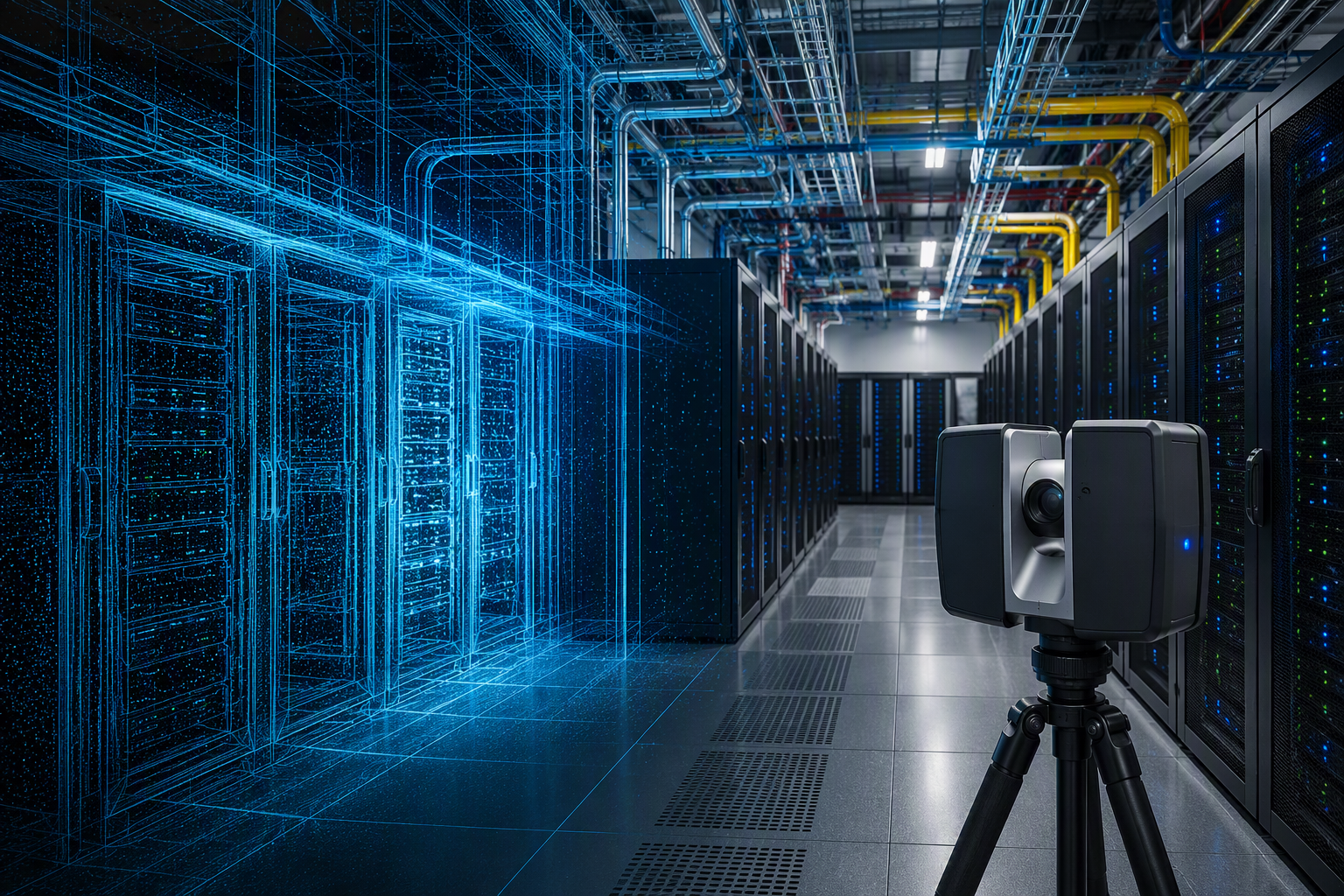
Increasingly, the answer is improved visibility and precision through 3D scanning.
The Core Advantage: Certainty in a Complex Environment
Traditional documentation methods—legacy drawings, manual measurements, and fragmented records—struggle to keep pace with modern data center complexity.
Over time:
- Infrastructure changes are not fully documented
- Drawings become outdated
- Field conditions diverge from design assumptions
This creates uncertainty at exactly the point where precision is most critical.
3D scanning changes this dynamic by providing:
- Accurate, current-state facility data
- Millimeter-level detail across all systems
- A complete digital representation of the environment
The result is a shift from assumption-based planning to reality-based decision-making.
And in a data center, that shift has direct implications for uptime, cost, and risk.
Creating Accurate As-Builts for Ongoing Operations
One of the most immediate benefits of 3D scanning is the ability to generate complete, up-to-date as-built documentation.
This includes capturing:
- Cable trays and pathways
- Mechanical and electrical systems
- Racks, equipment, and infrastructure
- Structural elements and clearances
Unlike traditional methods, this process:
- Captures the facility exactly as it exists today
- Documents changes over time
- Provides a reliable foundation for planning and compliance
Impact:
- Reduces reliance on outdated drawings
- Supports audits and regulatory requirements
- Minimizes downtime risk by ensuring teams operate with accurate information
It also significantly reduces the need for:
- Multiple site visits
- Manual measurements
- On-the-fly field decisions
Eliminating Rework Through Early Clash Detection
One of the most expensive risks in data center projects is discovering conflicts in the field.
These conflicts can occur between:
- New and existing systems
- Mechanical, electrical, and structural components
- Planned equipment and available space
When discovered late, they lead to:
- Change orders
- Fabrication delays
- Installation inefficiencies
- Extended outages or shutdown windows
3D scanning enables point cloud-based clash detection, allowing teams to identify these conflicts before construction begins.
This includes:
- Exact geometry of cable trays, ducts, piping, and racks
- Constraints that wouldn’t appear in legacy drawings
- Spatial conflicts that impact installation or access
Impact:
- Conflicts are resolved in design—not in the field
- Schedule delays are minimized
- Cost overruns are reduced
- Shutdown extensions are avoided
Minimizing Downtime During Upgrades
Upgrading critical infrastructure in a live data center is one of the highest-risk activities.
Examples include:
- UPS systems
- Battery racks
- Switchgear
- Generators
- Cooling systems
These components are:
- Large and expensive
- Difficult to reposition
- Critical to ongoing operations
3D scanning supports these upgrades by enabling teams to:
- Precisely measure clearances for new equipment
- Validate equipment fit before procurement
- Plan installation sequences with confidence
This reduces:
- Installation risk
- Schedule uncertainty
- Cost overruns
- Potential disruption to operations
Ultimately, it enables infrastructure replacement with minimal or no downtime.
Improving Safety in High-Density Environments
Data centers often involve:
- Congested mechanical and electrical spaces
- Energized equipment
- Hot aisle / cold aisle complexities
Without accurate planning, workers may face:
- Increased exposure to risk
- Last-minute adjustments in live environments
- Extended time in hazardous areas
3D scanning improves safety by enabling:
- Better pre-planning
- Reduced time spent in critical zones
- Fewer reactive adjustments during execution
Impact:
- Safer working conditions
- Reduced exposure to energized systems
- Lower risk of human error
Enhancing Asset Management and Visibility
Beyond planning and execution, 3D scanning also supports ongoing asset management.
By embedding asset data into digital models, organizations can:
- Tag and identify equipment within a 3D environment
- Quickly locate and verify assets
- Streamline inventory management
These models can integrate with:
- DCIM (Data Center Infrastructure Management) systems
- ERP platforms
- EAM systems
Impact:
- Faster asset lookup
- Improved lifecycle management
- Better visibility across infrastructure
Mapping Critical Infrastructure Pathways
In many facilities, one of the largest unknowns is cable and pathway routing.
Without clear mapping:
- Expansion planning becomes difficult
- Risk increases during modifications
- Troubleshooting takes longer
3D scanning enables:
- Detailed cable pathway mapping
- Clear visualization of routing and dependencies
- Better planning for future capacity
Strengthening Security and Risk Awareness
As the data center industry grows, so does the importance of physical and operational security.
Accurate facility data allows organizations to:
- Identify potential vulnerabilities
- Evaluate access and exposure points
- Improve planning for secure upgrades
While often overlooked, this layer of visibility contributes to broader risk management strategies.
The Strategic Impact: Less Risk, More Confidence
Across all these use cases, the benefits of 3D scanning converge around a single idea:
Reducing uncertainty at every stage of the lifecycle.
This translates directly into:
- Lower risk
- Reduced rework
- Faster project execution
- Improved cost control
- Greater confidence in outcomes
In an environment where even small errors can carry large consequences, this level of precision is not optional—it is increasingly expected.
Final Takeaway
Data centers are among the most complex and risk-sensitive environments in the built world.
Managing them effectively requires:
- Accurate information
- Coordinated planning
- Minimal tolerance for error
3D scanning enables organizations to meet these requirements by replacing assumptions with verified, real-world data.
In a world defined by uptime, the ability to see—and understand—your facility with precision is a critical advantage.
And increasingly, that precision is what separates successful projects from costly disruptions.
For more insights on facility data, scanning, and project planning, explore the full GMRticles library.
If you have questions, please contact us.
About GMR
Since 1991, GMR has been a pioneer in the field of ATM lighting surveys and has expanded its suite of services to include custom facility inspections, engineered lighting designs and 3D scanning for properties and facilities nationwide. GMR is a certified woman-owned business based in the Dallas-Fort Worth metroplex.
Want to learn more about how Lighting Design Markups can benefit your business? Contact us today.