
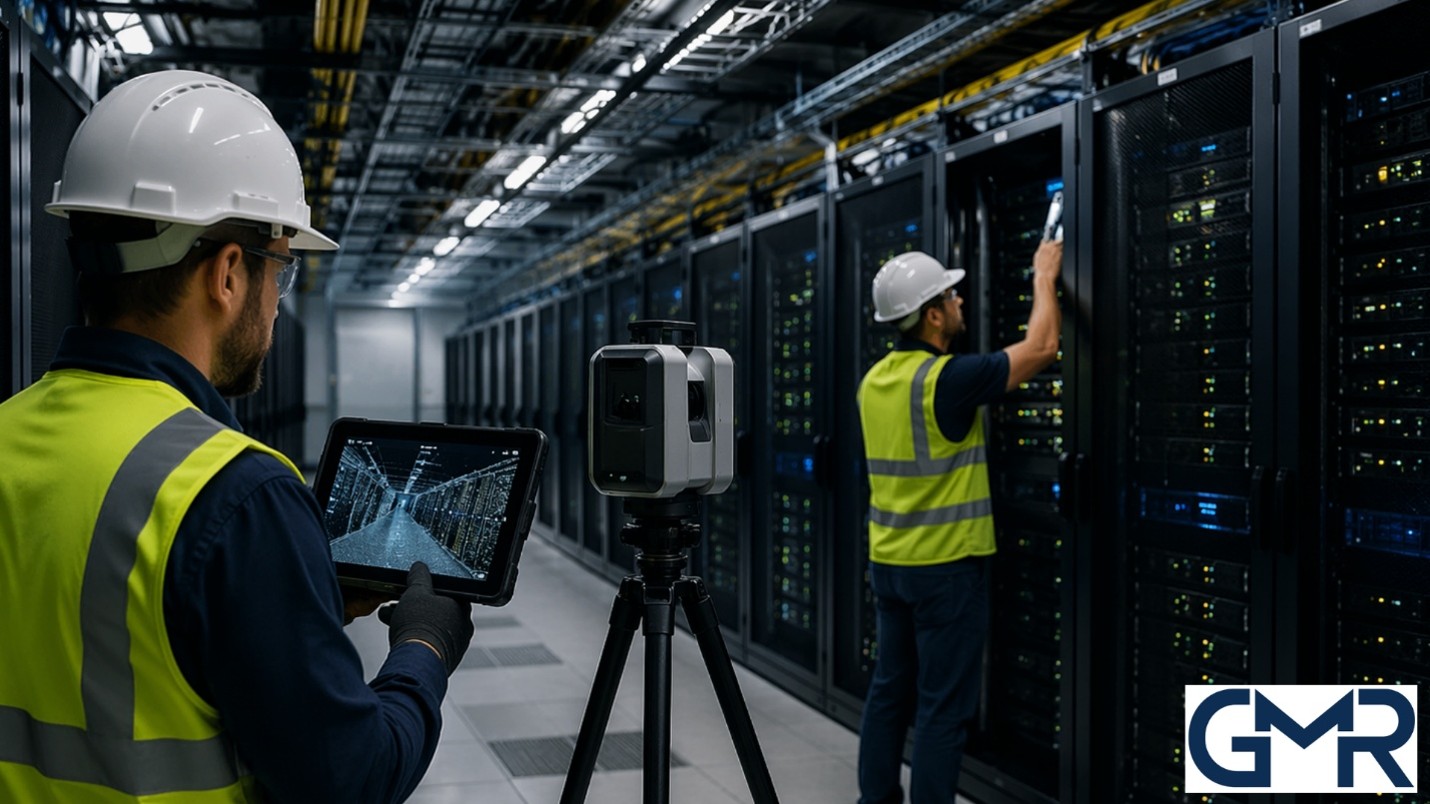
When design decisions are based on outdated or incomplete building data, costs escalate rapidly—often by millions.
Author: Kelly Moon
As demand for data center capacity accelerates, organizations are under increasing pressure to deliver projects faster, more efficiently, and with greater certainty. For many, retrofitting existing buildings presents an attractive pathway.
But there’s a persistent—and expensive—challenge:
Rework is one of the largest hidden costs in data center development.
Design revisions, field conflicts, construction delays, and infrastructure misalignment can quickly compound—turning what appeared to be a viable project into a significantly more expensive one.
In many cases, these costs are avoidable—and increasingly, organizations are turning to 3D laser scanning services to eliminate that risk early.
The Hidden Cost of Rework in Data Center Projects
Rework is rarely the result of poor engineering. Instead, it typically stems from a more fundamental issue:
Decisions are made using incomplete or inaccurate building data.
In retrofit scenarios, this problem is amplified.
Common sources of rework include:
- Conflicts between design models and real-world conditions
- Misaligned mechanical, electrical, and structural systems
- Inaccurate measurements leading to equipment fit issues
- Undocumented modifications discovered during construction
These issues don’t just create minor delays—they often trigger:
- Redesign cycles
- Costly change orders
- Installation inefficiencies
- Extended project timelines
Individually, these impacts are manageable. Collectively, they can cost millions and introduce significant execution risk.
Similar challenges have been seen across facility projects where outdated information leads to costly design errors and inefficiencies, as outlined in this example on 3D scanning for more efficient project planning.
Why Traditional Building Data Creates Risk
Many data center retrofit projects still rely on:
- Legacy as-built drawings
- Manual field measurements
- Disconnected or outdated documentation
These inputs are often:
- Outdated
- Incomplete
- Misaligned with current building conditions
Even small inaccuracies can cascade into major downstream issues:
- A few inches of error can prevent critical equipment from fitting
- Missing conduit pathways can disrupt electrical planning
- Undocumented structural elements can force redesigns
Without accurate verification through facility site inspections, teams are often working with incomplete or outdated information.
In a highly engineered environment like a data center, precision is not optional—it’s critical.
The Shift Toward Reality-Based Planning
To reduce rework and improve project outcomes, organizations are shifting from assumption-based workflows to reality-based planning.
At the center of this shift is 3D laser scanning, which captures highly accurate, real-world data about a building’s geometry and systems.
This enables the creation of:
- High-resolution spatial models
- Accurate digital representations of existing conditions
- Coordinated environments for design and engineering teams
Instead of designing against assumptions, teams are designing against verified reality—leveraging tools like 3D scanning services to ensure accuracy from the start.
How 3D Scanning Eliminates Rework
1. Accurate Existing Conditions from Day One
3D scanning captures millions of data points to represent the building exactly as it exists.
This eliminates:
- Measurement inconsistencies
- Missing structural or MEP components
- Gaps in documentation
Impact:
Design teams start with a complete and accurate foundation, reducing downstream risk.
2. Early Detection of Conflicts
When design models are built on accurate spatial data, conflicts can be identified before construction begins.
Examples include:
- Equipment clearance issues
- Mechanical and electrical system clashes
- Structural misalignments
Impact:
Issues are resolved digitally—not in the field, where costs are significantly higher.
3. Reduced Change Orders
Change orders are a primary driver of cost overruns in retrofit projects.
By validating conditions early:
- Fewer surprises emerge during construction
- Less rework is required
Impact:
More predictable budgets and improved financial control.
4. Improved Coordination Across Teams
Data center projects require coordination across:
- Architecture
- Engineering
- Construction
- Operations
3D scanning provides a single, accurate model that all teams can work from.
Impact:
Improved alignment, fewer miscommunications, and smoother execution.
5. Faster Project Timelines
Rework extends timelines and delays deployment.
Projects move forward with greater continuity by eliminating:
- Repeat site visits
- Redesign cycles
- Field adjustments
Impact:
Faster time-to-market and earlier operational readiness.
The Financial Impact: Why This Matters
Even small inefficiencies scale quickly in high-value environments like data centers.
Consider the cumulative cost of:
- Multiple design revisions
- Equipment relocation or reinstallation
- Delays in critical path activities
These factors can result in:
- Six-figure overruns on smaller projects
- Multi-million-dollar impacts on larger conversions
By reducing rework, organizations aren’t just improving efficiency—they’re protecting project economics.
Implications for Building Owners
For building owners exploring data center conversion opportunities, rework risk is a critical—yet often underestimated—factor.
Without accurate building intelligence:
- Feasibility assumptions may be flawed
- Project costs may be underestimated
- Timelines may become unrealistic
This can lead to:
- Investment in nonviable opportunities
- Unexpected capital requirements
- Loss of credibility with partners and stakeholders
For this reason, many organizations pair scanning with broader evaluations like property condition assessments to fully understand building readiness before committing capital.
The Strategic Shift
The industry is moving toward a simple but important principle:
The earlier you understand real-world conditions, the less you pay for them later.
3D scanning enables this shift by delivering clarity at the earliest stages—where the cost of change is lowest, and the impact is highest.
Final Takeaway
Rework in data center projects is not inevitable—it’s a byproduct of uncertainty.
Organizations that rely on incomplete or outdated building data are far more likely to experience:
- Design conflicts
- Delays
- Cost overruns
Those that invest in accurate, reality-based building intelligence reduce these risks significantly.
In modern data center development, precision early isn’t an advantage—it’s a requirement.
And increasingly, 3D laser scanning is what makes that level of precision possible.
For more insights on facility data, scanning, and project planning, explore the full GMRticles library.
If you have questions, please contact us.
About GMR
Since 1991, GMR has been a pioneer in the field of ATM lighting surveys and has expanded its suite of services to include custom facility inspections, engineered lighting designs and 3D scanning for properties and facilities nationwide. GMR is a certified woman-owned business based in the Dallas-Fort Worth metroplex.
Want to learn more about how Lighting Design Markups can benefit your business? Contact us today.